Crisis of faith
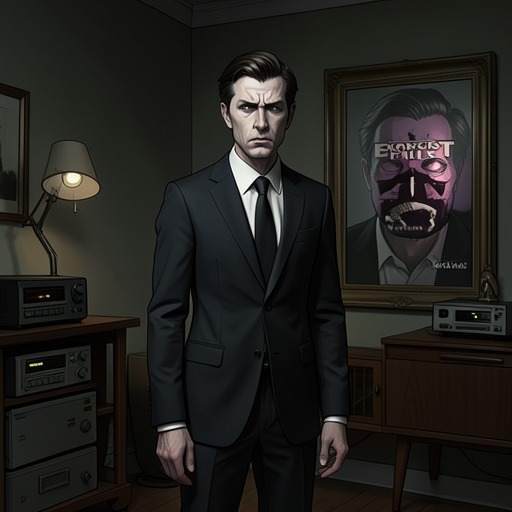
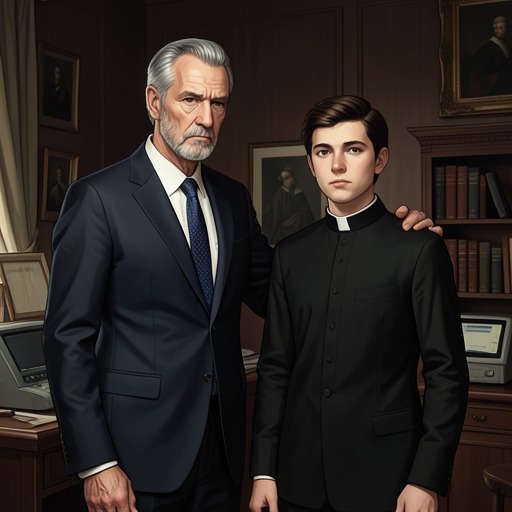
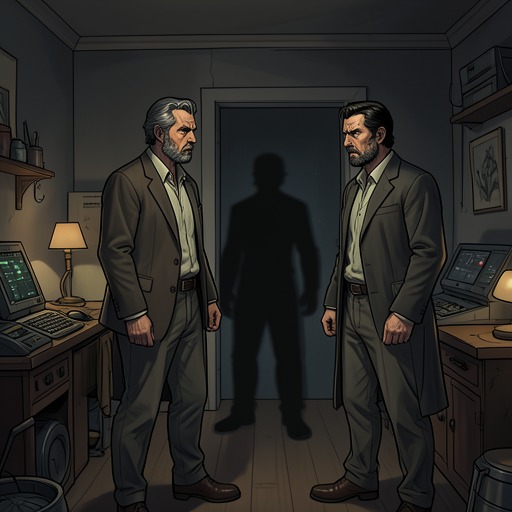
Exorcist FallsCrisis of faith names the religious doubt that takes hold of Jason Crowder and later emerges openly in Peter Sutherland and Joe Patterson. In a story where a child’s body appears both grievously injured and inexplicably healed, faith is not a settled alternative to reason: it is a fragile commitment tested by medical danger, demonic deception, apparent complicity, and the suffering of people who do not deserve it. The state changes through action. Jason’s faith wavers, returns as a choice to defend Casey Hartman, and remains unresolved even when supernatural events become difficult to deny.
Jason Crowder’s First Crisis
Jason’s crisis begins not with a formal argument but with a change in his experience of prayer. As Peter Sutherland prays over Casey, Jason finds that the words do not comfort him or give him resolve. Instead, they fill him with dread. He understands that he is not a detached observer of an unusual case: he may be involved in it centrally. The moment establishes a recurring pressure in his faith: the sacred encounter he might expect to steady him instead exposes how little control he has over what is happening.
That uncertainty first takes a practical form in the dispute over diagnosis and treatment. Facing Casey’s condition, Jason tries to speak with the caution he associates with Sutherland, insisting that no one should speculate before seeing the child and that possible explanations include a seizure or an undetected psychological condition. Sutherland, however, warns the Hartmans that mistaking illness or play-acting for possession can cause grave harm. He recounts two disastrous cases: a woman with an untreated personality disorder deteriorated and died in an institution after being labelled possessed, while a child who feigned possession injured herself, later abused drugs, and died of a heroin overdose at nineteen. In two other cases that met the conditions for possession, the victims recovered after exorcism. His account gives the decision immediate stakes: religious certainty can itself injure, but refusing to act may also be fatal.
When Casey’s knees appear ruined and his hands and feet drained of color, Jason wants to get him to a hospital. Sutherland says Casey will be dead before they arrive and calls intervention his only hope. Jason cannot make the visible damage fit a consoling explanation. Sutherland points him instead to Casey’s wrists and fingertips, where flesh appears to be returning, and insists that the apparent violence is an illusion intended to break their will. Jason does not fully accept that the injuries are unreal; he chooses to trust Sutherland’s judgment enough to continue the rites. The scene makes faith neither easy conviction nor proof that suffering is imaginary. It is a decision made under pressure, while the body before Jason seems to contradict the explanation he is being asked to trust.
Faith Tested by Casey’s Possession
The exorcism sharpens Jason’s conflict between religious intervention and medical care. After the rites, Casey appears to be sleeping peacefully, but Jason remains concerned about his heart and raises sedation as a possibility. Sutherland rejects involving doctors or paramedics because they would likely sedate Casey, which he believes could be disastrous. Jason has already seen a terrifying bodily ordeal and an apparent regeneration; neither observation gives him a safe, ordinary framework for what he has witnessed. Sutherland later admits that he lied to the Hartmans to obtain permission for the exorcism. In the failed case he had assisted, Sutherland himself had wanted medical attention; the lead priest turned to modern medicine rather than driving the demon out swiftly, and the outcome was catastrophic. His admission makes the theological conflict personal: his present certainty grew out of an earlier failure and a change in what he believed about the proper relation between faith and scientific reasoning.
The demon then attacks the trust on which Jason has relied. It makes explicit accusations about Sutherland and the Sweet Sixteen killings, including a claim about a murdered victim’s severed finger. Sutherland tells Jason that the demon is lying and explains that it could draw on information from a man who confessed to him. Jason cannot dismiss the allegation simply because it comes from a demon: he considers whether Sutherland could be the killer, or whether a priest who heard the killer’s confession has absorbed the murderer’s poisonous thoughts. His crisis is thus also a crisis of trust in a mentor he has revered for eleven years. Yet the question of Sutherland’s guilt becomes secondary to Casey’s fate. Jason remembers the boy as polite and cheerful, with a baseball cap, a fondness for the Beatles and LeBron James, and Sunday-morning kindness. Whatever Casey may or may not have to do with the murders, Jason concludes that he does not deserve to die or to be tortured and displaced by a presence beyond human understanding. Jason rises and commands Malephar to leave the boy’s body. Faith becomes an obligation to protect the vulnerable, not a verdict on whether the people around him are innocent.
Innocence, Evil, and Human Responsibility
The novel repeatedly puts the problem of innocent suffering into direct speech. During a confrontation with an armed young man, Jason asks whether he believes God makes people suffer. The man answers that God does not care, if God exists at all; Jason replies that God exists and will never abandon him. The assurance is firm, but the exchange supplies no explanation for the man’s pain. Likewise, when Liz Hartman asks why her son has been victimized by a demon, Jason’s response that the world is fallen does not satisfy her. She rejects any suggestion that Casey’s suffering is their fault or Eve’s. These moments expose the distance between a religious formula and a person demanding an account of an actual wound.
Jason’s doubts intensify when Liz identifies Julia Deveroux as the victim of a murder and explains that she had been walking home from Saint Anthony’s after late play practice. Later, hearing that another murder took place at Farris Park, Jason realizes that someone else had been there: someone with intimate knowledge of the Sweet Sixteen Killer’s habits and a momentary experience inside the killer’s mind. The recognition fills him with dread, but he cannot yet make himself accept what it may mean. The supernatural knowledge that could clarify a crime instead implicates human beings in further violence. Against this uncertainty, the question of Casey’s deservingness remains firm; understanding the cause of evil does not make its victim responsible for it.
Patterson’s Doubt and the Limits of Explanation
Joe Patterson’s account of his daughter Ariana’s accidental death deepens the crisis beyond possession. He describes his anxious attention to her safety, contrasting it with his wife Laura’s freer temperament. He had thought that physical safety had to come first; she warned that his manias could stunt Ariana’s emotional growth. At Turkey Run, Ariana fell into deep water and was not found until a diver went in. Patterson remembers that he had assumed the water was shallow and rocky. Jason tells him it was an accident and that he loved his daughter, but Patterson corrects him: he still loves her. The correction refuses the past tense Jason’s reassurance seems to imply. Compassion can acknowledge his grief, but it cannot reverse the accident or erase Patterson’s enduring bond and pain.
After the reservoir confrontation, Patterson tells Jason that the encounter with Malephar shook him. He has questioned his faith, particularly after Ariana’s death, and wonders how anyone can be blamed for being born in a country where they have never heard of Jesus. He also condemns the habit of separating people by difference, treating them as lost while assuming one already possesses the answers; in his view, everyone is lost and everyone has sinned. Jason recognizes that he had misjudged Patterson as sanctimonious and prone to judging others. Patterson then confesses that he had never believed in demonic possession, privately treating it as superstition or overreaction even while his superiors discussed it. His admission shows that possession has not simply confirmed an unshaken religious worldview: it has disrupted his former skepticism while leaving questions about faith, judgment, and suffering alive.
An Unresolved, Active Faith
Jason’s later possession by Malephar makes faith a struggle for bodily and moral agency. The demon has been inside him for two nights, trying to control him as it controlled Casey; once, Jason woke at a bathroom mirror with a razor drifting toward his throat. He plans to exploit the demon’s attempt to govern him, but cannot be certain it will seize control when he needs it to—or that he will regain control afterward. In the reservoir, Malephar claims to have saved his life. Jason recognizes that the demon’s act served its own continued existence, not his well-being, and continues the rites even while acknowledging that the rescue was real. His response allows no simple division between supernatural power and moral goodness: an act that preserves a life does not absolve the being that performed it.
Patterson saves Jason, who is taken by ambulance to the hospital for the second time in a week. A doctor finds that the wound in his side looks as though it was inflicted a month earlier and has mostly healed. Jason feels grateful to Malephar for the healing, but knows the demon has not been destroyed: it has sunk to the reservoir’s bottom, its uninjured red eye still fixed in hatred. Neither the medical examination nor the apparent supernatural recovery resolves the conflict between the two ways of understanding his body. The demon remains alive, and Jason’s gratitude coexists with his determination to resist it.
Crisis of faith therefore persists as a condition rather than a problem solved by revelation. Sutherland’s experience makes him reject the assumption that religious belief must yield to modern medicine in every possession case; Patterson moves from private disbelief toward a shaken, more self-critical faith; Jason acts without acquiring a complete explanation for suffering or certainty about every person’s innocence. What steadies him is narrower and more demanding: Casey must not be abandoned, apparent evil must be opposed, and survival—even when Malephar contributes to it—does not make Malephar good. The novel makes belief consequential less as an answer to why suffering occurs than as a test of what a person will do while the answer remains out of reach.